Student Loan Wage Garnishment Restart: What’s Real and What to Do
Student loan wage garnishment is back in the headlines, and some of them read as if paychecks get hit tomorrow. I read the Education Department’s own releases and the main reports from the past two weeks. The picture is less settled than the headlines. Nothing official says garnishment has restarted. One report says the government is getting ready to, and the timing depends on which outlet you read.
This only touches you if you hold federal loans in default, which usually means 270 days without a payment. If you’re current, you can skip the rest. If you’re not sure where you stand, it’s worth ten minutes this week.
What’s confirmed, and what’s only reported
Here’s the record as I pieced it together from the department’s releases and CNBC’s coverage.
| Date | What happened | Where it comes from |
|---|---|---|
| April 2025 | The administration said it would resume collections on defaulted loans, which had been paused since 2020 | CNBC |
| December 2025 | The department said about 1,000 borrowers would get garnishment notices the week of Jan. 7 | CNBC |
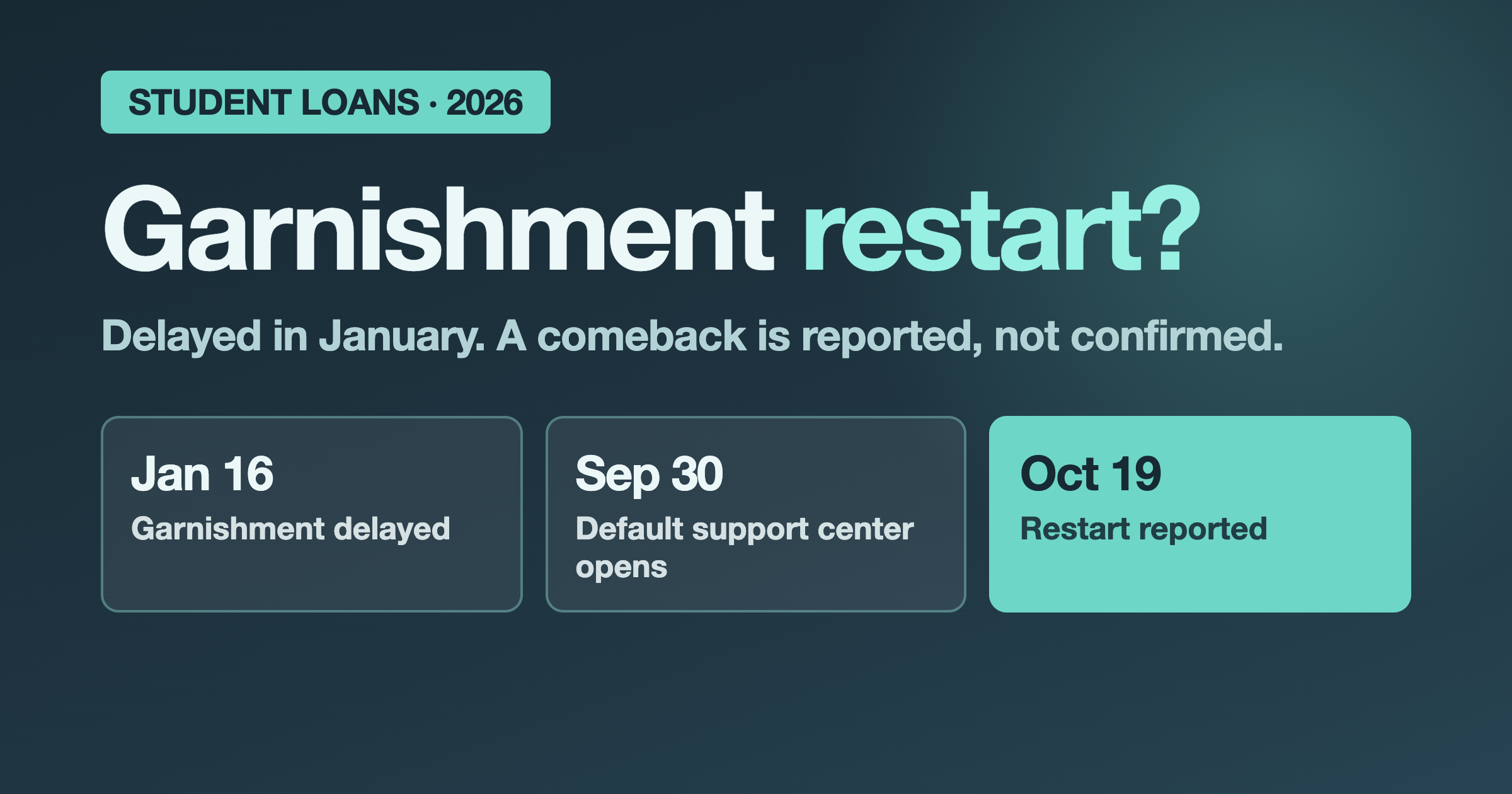
| Jan. 16, 2026 | Wage garnishment and the Treasury Offset Program were delayed so borrowers could use new repayment options | Education Department release |
| March 2026 | The department and Treasury announced that Treasury would take over collecting defaulted loans | CNBC |
| July 1, 2026 | A new income-driven plan was scheduled to open under the new law | Education Department release |
| Sept. 30, 2026 | The Defaulted Loans Support Center opened on StudentAid.gov | Education Department release |
| Oct. 19, 2026 | NOTUS reported officials are preparing penalties for defaulted borrowers next year | NOTUS, five unnamed sources |
Everything down to September is on the record. The last row is only a report. The department’s reply in that story was “We don’t respond to fishing expeditions,” and Forbes says a spokesperson denied the rumors.
The scale is why people care. Federal Student Aid, as quoted by Yahoo Finance, counts about 9.3 million borrowers in default. They owe $234 billion as of June 2026.
Fall or 2027? The reports disagree
The College Investor says garnishment restarts this fall, once borrowers’ window to pick a new repayment plan closes. NOTUS points to 2027 instead. Treasury wants its debt collector contracts and its new support center ready first. Some officials want to act for the current tax year, which the report ties to the April 15, 2027 deadline. One source in that story said doing it before the midterms would be “politically insane.”
I lean toward the NOTUS version. It has more detail, and the department already announced garnishment once and pulled it back within weeks. A delay isn’t a cancellation, though. The department’s own January release called it a “temporary delay.” The sensible plan is to treat 2027 as the likely date and prepare as if it could come sooner.
How student loan wage garnishment works
Only federal loans in default can be hit this way. The Independent says default starts at 360 days late. CNBC and Forbes both say 270, about nine months, so I used 270. Private lenders generally have to sue first, according to Forbes. The federal government doesn’t.
It can order your employer to hold back up to 15% of your disposable pay. It can also take your tax refund through the Treasury Offset Program and offset federal benefits such as Social Security. A tax preparer quoted by Yahoo Finance said garnishment still has to leave you 30 times the federal minimum hourly wage each week.
My math on the 15%: with $900 a week in disposable pay, the most that can be taken is $135 a week, or about $585 a month. The College Investor says that can cost 50% more than an income-driven plan, which asks for roughly 10% of discretionary income. The two use different bases, so I’d treat the 50% as a ballpark. The same piece says most of what’s collected goes to fees and interest first, so the balance barely moves.
Married and filing jointly? If only one spouse owes the debt, the tax preparer in the Yahoo piece said the other spouse may be able to protect their share of a refund with IRS Form 8379.
Ways out, and who each one fits
The right route depends on two things: how fast you need collections to stop, and whether the default mark on your credit report matters to you.
| Option | What it does | The catch |
|---|---|---|
| Rehabilitation | Nine on-time payments based on your income, made within ten months. The default comes off your credit history and garnishment stops. | It takes months. The new law gives a second chance at it, according to the department. |
| Direct consolidation | Rolls defaulted loans into a new loan that isn’t in default, and requires an income-driven plan. | The default stays on your credit report. |
| Objection | Stops or reduces garnishment if the debt isn’t yours, you’re in bankruptcy, or you’re totally and permanently disabled. | Has a deadline set in your notice. The Independent, citing the department, puts it at 65 days. |
| Payment arrangement | Lowers your monthly payment and holds off garnishment if the first payment lands on time. | The loan stays in default. |
| Discharge | Wipes the loan for total and permanent disability, a school closure, or qualifying forgiveness programs. | You have to apply, and approval isn’t guaranteed. |
Nick Avila of United Debt Relief, quoted by Yahoo Finance, said consolidation is usually faster but the default stays on record. For most people who can manage nine payments, he called rehabilitation the better long-term path. The department says approved rehabilitation applications are up 69% since the Treasury partnership began. Consolidations out of default are up 95%. Borrowers are already moving.
Why I wouldn’t wait for the notice
Say you start rehabilitation in November. Nine monthly payments run through July 2027 (my math: November to July is nine months). That lands after the April 15 filing deadline. I couldn’t confirm whether a rehabilitation agreement in progress pauses a refund offset. I’d plan as if it doesn’t.
Stopping is also slower than people expect. The College Investor says small employers that run payroll by hand can take weeks to start a garnishment and weeks to stop it. You can keep losing 15% of a paycheck after the loan is technically out of default. Acting before an order exists avoids that lag.
A short list for this week
- Log in at StudentAid.gov and check the status of every federal loan.
- If anything is in default, look at the Defaulted Loans Support Center, where you can apply for rehabilitation or consolidation online.
- Open every notice that arrives and write down its deadline. Missing that window is how people lose options, according to the Yahoo piece.
- Don’t build a 2027 budget around a tax refund if you’re in default.
- Keep housing, utilities and insurance current first. If you’re totally and permanently disabled, check discharge before anything else.
The short version
Nothing official says wage garnishment has restarted. The department called January’s delay temporary, and one report says collections are being prepared. If your federal loans are in default, start rehabilitation or consolidation now instead of waiting for a notice.
Facts and figures were checked against the sources below when this was written. Things change fast, so confirm with the official page before you act on anything here.
Sources
- U.S. Department of Education: delay of involuntary collections (Jan. 16, 2026)
- U.S. Department of Education: Defaulted Loans Support Center launch (Sept. 30, 2026)
- NOTUS: Trump aides are getting ready to penalize defaulting student loan borrowers (Oct. 19, 2026)
- The College Investor: wage garnishment on defaulted student loans restarts this fall
- CNBC: Education Department to delay collections on defaulted student loans (Jan. 16, 2026)
- CNBC: Treasury to manage student loan collection (Mar. 20, 2026)
- Yahoo Finance: Trump officials reportedly coming for paychecks, tax refunds and Social Security
- The Independent: how to fight back against wage garnishment (Oct. 26, 2026)
- Forbes: student loan borrowers can stop the Education Department from taking their wages (Oct. 26, 2026)