Daylight Saving Time Ends November 1: Who Changes Clocks, Who Doesn’t, and How to Adjust
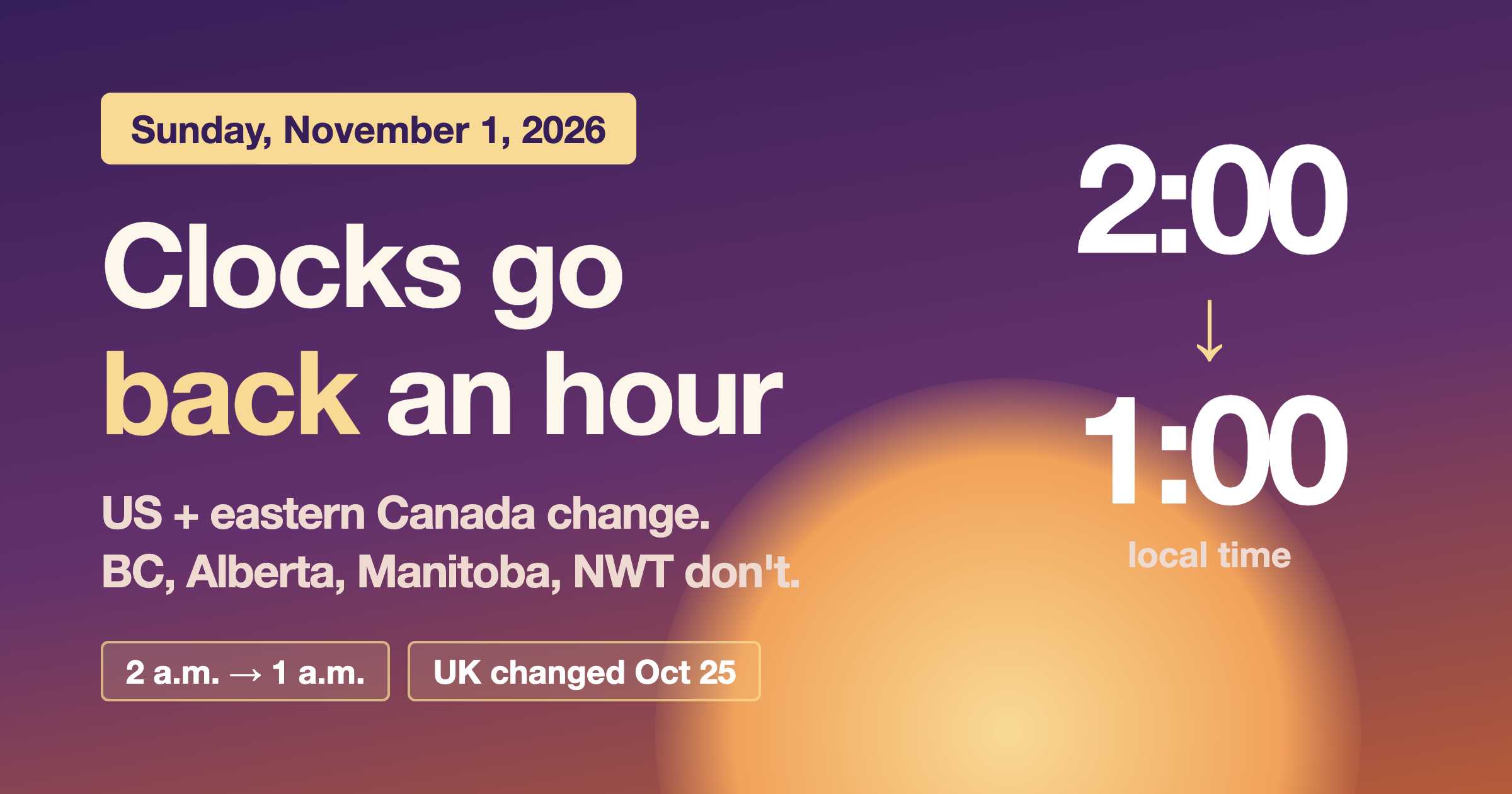
Daylight saving time ends on Sunday, November 1, 2026, at 2 a.m. local time in the United States and most of Canada. Clocks go back one hour, so 2 a.m. becomes 1 a.m. and you get that hour again. Simple enough. Except this year a big chunk of Canada is not changing at all, the UK already changed a week earlier, and your phone will probably handle it before you wake up. I went through the NIST rules, the tz database release notes and a few official pages to sort out who changes, who does not, and what to do about it.
The basic rule, from NIST
US law puts the change on fixed Sundays. NIST, which runs the national time standard, spells it out: DST “begins at 2:00 a.m. on the second Sunday of March” and “ends at 2:00 a.m. on the first Sunday of November.” For 2026 that is March 8 to November 1. On the fall night, “at 2 a.m. the local time becomes 1 a.m. and that hour is repeated.”
By the same rule, clocks spring forward again on March 14, 2027. That date is my own reading of the rule, since the NIST page does not list 2027 yet.
Who does not change clocks in the US
NIST lists the places that stay put all year: “DST is not observed in Hawaii, American Samoa, Guam, Puerto Rico, the Virgin Islands and the state of Arizona.” There is one twist inside Arizona. The Navajo Nation does observe DST, so if you drive across northern Arizona on Sunday you can cross a time boundary twice without leaving the state.
Everyone else in the US falls back. That includes Alaska, which is a question I see every year.
Canada is the messy one this year
Saskatchewan and Yukon have skipped the clock change for years. In 2026 four more regions joined them, according to the tz database, the list that phones and computers use to know what time it is. The notes say British Columbia “moved to permanent -07 on 2026-03-09,” Alberta “moved to permanent -06 on 2026-06-18,” the Northwest Territories “moved to permanent -06 on 2026-08-21,” and Manitoba “moves to permanent -05 on 2026-10-31.”
In plain terms, all four stay on their summer clock. They will not fall back on November 1. The rest of Canada, including Ontario, Quebec and the Atlantic provinces, changes as usual.
| Region | November 1, 2026 |
|---|---|
| Ontario, Quebec, Atlantic Canada, Nunavut | Clocks go back one hour |
| British Columbia | No change (stays at UTC-7, same as summer) |
| Alberta, Northwest Territories | No change (stays at UTC-6) |
| Manitoba | No change (stays at UTC-5) |
| Saskatchewan, Yukon | No change, as in past years |
One loose end is northwestern Ontario, the part that historically kept Winnipeg time. The tz notes say it is “not yet known whether or to what extent these areas may adapt.” If you live near Kenora, check your municipality. The Canada West Foundation explainer is a good plain-language read on why the western provinces went their own way.
My take: this is going to cause a lot of missed meetings in November. Calgary and Toronto are normally two hours apart. From November 1 they are only one hour apart until March. Vancouver and Seattle, usually the same time, will be an hour off all winter.
The UK and Europe already changed
The UK went back to GMT on Sunday, October 25, the last Sunday in October, as the GOV.UK page lays out. Most of Europe did the same. So for one week, October 25 to November 1, the gap between London and New York is four hours instead of five. My math, but worth a glance before you book a transatlantic call this week.
What actually changes when daylight saving time ends
- Phones, laptops, smart speakers: they update themselves at 2 a.m. as long as automatic time zone is on. Check that setting tonight if you have ever turned it off.
- Ovens, microwaves, car dashboards, wall clocks: these do not. Do them Sunday morning so you are not an hour early for everything next week.
- Older cars and some cameras: same as above. Cameras with the wrong time stamp photos wrong for months.
- Sunset: gets an hour earlier on the clock. In the northern US that means dark by 5 p.m. right away.
- Alarms: an alarm set for 6 a.m. still goes off at 6 a.m. on the new clock, which is 7 a.m. on your body’s old clock.
How to handle the extra hour without feeling off
The fall change is the easy one. The Sleep Foundation says major sleep disruptions are less likely in November because most people simply get an extra hour. Still, “some people have difficulty adjusting to a new wake-up time,” and effects “gradually subside over a few days or weeks.”
The page’s tips are mostly about habits, not tricks:
- Keep the same sleep and wake time every day, including the weekend of the change.
- Get outside in the morning. Morning light is what resets your body clock.
- Keep naps to 20 minutes or less.
- Skip caffeine close to bedtime and skip alcohol as a sleep aid, since it lowers sleep quality.
- Melatonin only with a doctor’s input. The page quotes Dr. Dustin Cotliar saying it “can be helpful” but “in consultation with your doctor.”
I would add one thing from experience with earlier sunsets, not from a study. Eat dinner at the usual clock time on Sunday, even if it feels early. It anchors the evening faster than anything else.
A few things people ask every year
Do I get paid for the extra hour on a night shift?
In the US, hourly workers are paid for hours actually worked, so a shift that runs through 2 a.m. is one hour longer and should be paid that way. Check your employer’s policy, since this is a general rule and not legal advice.
Will this be the last time we change clocks?
Not in the US. Permanent-time bills have passed one chamber of Congress before and stalled. Canada is where the real movement is, and the 2026 changes in BC, Alberta, Manitoba and the Northwest Territories are a big step. I could not find any state that has made a change effective for 2026.
What about Mexico and Australia?
Most of Mexico stopped changing clocks in 2022. Southern Australian states are in the middle of their summer time, which started in October and runs until April. I did not verify the exact Australian dates for this post.
The short version
Daylight saving time ends Sunday, November 1, 2026, at 2 a.m. in the US and eastern Canada. Arizona, Hawaii, the US territories, and now BC, Alberta, Manitoba and the Northwest Territories do not change. The UK already fell back on October 25.
Facts and figures were checked against the sources below when this was written. Things change fast, so confirm with the official page before you act on anything here.